Ph.D. Student Symposium
The Society for Cognitive Science / Gesellschaft für Kognitionswissenschaft as set itself the goal of promoting networking among doctoral students in the field of cognitive science in Germany. The primary goal is to offer doctoral students in cognitive science more opportunities for active exchange, particularly with regard to dialogue that transcends disciplinary boundaries and specific methodological approaches. This networking initiative among doctoral students in cognitive science is intended, on the one hand, to strengthen interdisciplinary cognitive science research in Germany and, on the other hand, to expand collaboration among the various cognitive science centers in Germany. Overall, the Society for Cognitive Science hopes that this will increase the visibility of cognitive science research in Germany.
To this end, the Society regularly offers financial support for the organization of a “PhD Student Symposium on Cognitive Science” with a thematic focus of the applicant’s choosing. As a rule, this symposium is announced for the calendar year in which the Society for Cognitive Science does not hold its annual conference.
Financial Support:
Up to 5,000 euros for the best concept. The budget may be used for travel expenses, lodging costs, and costs for support staff. Costs for meals or venue rental are not covered. It is expected that a local grant will be provided and that the participation fee, if any, will be minimal—no more than 25 euros per person. Funds will be transferred based on documented expenses.
Organizational Details:
Duration: at least 2 full days (ideally 2.5 days)
Timeframe: Typically in the spring of the year in which no academic conference is held.
Language of the symposium (for all technical discussions): English
Target number of participants:
40–50 participants, 20 of whom are not affiliated with the host university.
Application Requirements
The proposal should be financially transparent and realistically feasible. Any planned personal contribution must be confirmed in a statement by the applicant who holds the professorship, certifying that the funds are definitely available for this project. In addition, participation fees must be specified in the application if they cannot be avoided. Proposals that require no or only minimal participation fees will therefore have an advantage in the selection process. In addition, a current topic of focus must be selected that can be effectively addressed using at least two methodological approaches. Furthermore, an innovative structural concept is expected that clearly outlines how participants can actively engage through presentations, posters, or discussions. The structural concept is another important factor in the selection process.
Required Documents (in German or English):
- Program Concept (max. 2 pages)
- Structural Design of the School with a Focus on Supporting and Networking Doctoral Students in Cognitive Science (max. 2 pages)
- Financial plan, including, if applicable, a breakdown of participation fees and the applicant’s own contribution (Important note: Increases in or the introduction of participation fees after the application has been approved will not be accepted. In such cases, the right to receive funding will be forfeited because the conditions of approval have not been met) (max. 1 page)
- A statement from a professor assuming overall financial responsibility for organizing the symposium.
Applicant Team:
Applications must be submitted by a group of at least three doctoral students from at least two institutes working in different disciplinary or methodological areas. The applicant team may consist of up to five people.
Application Deadline and Submission:
Specified in the current call for proposals.
Decision:
The Executive Board of the Society for Cognitive Science / Gesellschaft für Kognitionswissenschaft will decide on the submitted applications.
Previous Ph. D. Student Symposia
Cognitive Science Conference of Students (CoSCoS 2025)
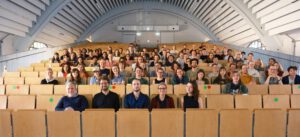
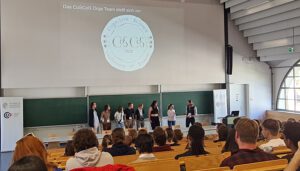
The first Cognitive Science Conference of Students (CoSCoS 2025) took place at TU Darmstadt over the weekend of May 9–11, 2025. Born out of an initiative by cognitive science students in Darmstadt, CoSCoS succeeded in creating a special space for academic and personal exchange among the approximately 120 students in Darmstadt and other guests from all over Germany, with participants from Osnabrück, Tübingen, Potsdam, and Kaiserslautern, among other places. Thanks to an accessible format, free participation, meals, and lodging for out-of-town guests, the event successfully attracted primarily students in their early semesters. About three-quarters of the participants were undergraduate students.
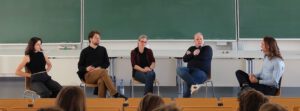
During several specialized presentations and an interdisciplinary panel discussion on the future of cognitive science and artificial intelligence, participants had the opportunity to engage with the speakers and panelists. In addition to the academic program, there were a variety of workshops and interactive group projects, organized by students for students.
CoSCoS 2025 was supported by, among others, the Gesellschaft für Kognitionswissenschaft, the Gesellschaft für Informatik (Artifical Intelligence Division), and the Centre for Cognitive Science at TU Darmstadt.
Impressions:
particiant photo:
Orgateam:
Panel Discussion:
Symposium on “From Minds to Movements: Foresight in Cognition and Activism” at the University of Vienna
08.-10. May 2025
Organizers: Ohan Hominis, Maria Fedorova, Xueyi Yao, and Bojin Zhu
“From Minds to Movements: Foresight in Cognition and Activism” was a hybrid, interdisciplinary graduate conference exploring the topic of future thinking through the lens of cognitive science, philosophy, and activism. The first two days of the conference were held at Aula am Campus Hof 1.11. These days featured workshops on Conceptual Change and Climate Activism, alongside presentations by PhD and postdoctoral researchers in philosophy and cognitive science. On the third day, the conference moved to the Sky Lounge at Oskar-Morgenstern-Platz 1, combining further research presentations with a closing discussion of future directions of research.
The conference coincided with a panel discussion on Current Crises, Possible Futures with Ali Emre Benli (University of Vienna), Brigitte Krenn (OFAI), and Simon Rippon (CEU), organised jointly with the Vienna Cognitive Science Hub.
Symposium on “Understanding Context in Cognition” at the University of Tübingen
07.-09. April 2025
Organizers: Ghada Hassan, Max Mittenbühler, Johanna Theuer, Mudar Adas, and Polina Tsvilodub
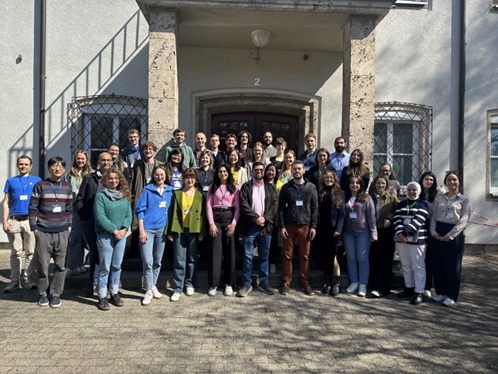
From April 7–9, 2025, the University of Tübingen hosted the “Understanding Context in Cognition” Doctoral Symposium, a 2.5-day event dedicated to exploring how context influences human cognition. Organized by five Cognitive Science PhD students— Ghada Hassan, Max Mittenbühler, Johanna Theuer, Mudar Adas, and Polina Tsvilodub—and funded by the German Cognitive Science Society, the symposium provided a vibrant platform for knowledge exchange among PhD students and senior researchers from across Germany.
The symposium emphasized interdisciplinary exchange, integrating perspectives from event cognition, artificial intelligence, psychology, cognitive modeling, and anthropology. It brought in about 60 registrations, including master students, PhD researchers, postdocs. Senior researchers from various universities and cognitive science backgrounds who were invited to the event also participated throughout the symposium events. All talks were recorded and most are being published on YouTube to reach a broader audience.
The program included keynote talks, workshops, PhD talks and two poster sessions as well as a project challenge, all of them being met with great engagement and positive feedback, significantly contributing to the success of the event.
Keynote talks
- Prof. Dr. Martin Butz – “How do we actively contextualize our behaviour?”: Prof. Butz presented a computational perspective on how the brain infers abstract contexts from spatiotemporal structure to enable adaptive, efficient behavior. He concluded with a comparison to current limitations of large language models (LLMs) and future development directions.
- Prof. Dr. Tanya Marie Luhrmann – “Voices”: Drawing from extensive cross-cultural research, Prof. Luhrmann discussed auditory hallucinations in clinical and non-clinical populations, emphasizing cultural factors and psychological traits shaping these experiences and their implications for understanding consciousness.
Workshops
- Dr. Marcel Binz – “How context influences prediction”: Participants explored how contextual variables affect LLM predictions using user movie ratings. The session involved practical modeling tasks and discussions on identifying user preferences.
- Dr. Sarah Schwöbel – “Contextual inference in Bayesian cognitive modeling”: The workshop took place as an interactive introduction to Bayesian models of contextual inference and decision-making. Dr. Schwöbel used Jupyter notebooks, enabling participants without much prior technical knowledge to learn the first practical steps of Bayesian modeling.
- Dr. Asya Achimova – “Applying for third-party funding” (not recorded): A hands-on guide to the grant application process, covering funding sources, proposal development, and support resources available at the University of Tübingen.
PhD Talks and Poster Sessions
The symposium featured 11 PhD talks, 10 of which were recorded. Each presentation consisted of a 10-minute talk followed by a 5-minute Q&A session. The talks showcased a wide range of topics, reflecting the interdisciplinary nature of the event. Research areas included artificial intelligence, robotics, neurocognitive science, philosophy of mind, and cognitive psychology.
In addition, we hosted two poster sessions after an enthusiastic request from participants to extend the first round. Across both sessions, 15 posters were presented over a total of three hours, allowing ample time for in-depth discussion. All abstracts for the talks and posters are available on our website.
Project Challenge
The project challenge served as a central interactive component of the symposium, encouraging interdisciplinary collaboration on the topic of context in cognition.
Participants were grouped based on diverse academic backgrounds and areas of expertise to foster cross-disciplinary dialogue. Each group was tasked with conceptualizing a novel research project that explores context in cognition, with an emphasis on originality, feasibility, and theoretical contribution.
Seven groups presented diverse and fascinating project proposals. Then participants voted to elect the winning team, which received small prizes.
Symposium on Individual Differences at the RPTU Kaiserslautern
12.-14. November 2024
Organizers: Hannah Plueckebaum, Jan Petershans, Laís Muntini and Zhino Ebrahimi
From November 12th to 14th 2024, the Center for Co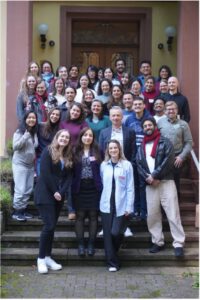 gnitive Science at the RPTU University Kaiserslautern-Landau hosted the 2024 Doctoral Symposium on Cognitive Science at the Villa Denis in the Palatinate Forest, Frankenstein, Germany. The event brought together approximately 60 attendees, including 37 enthusiastic PhD candidates alongside professors and colleagues, from 17 institutions across Europe to explore the topic “Beyond Averages – Individual Differences in Cognition”.
The symposium offered insights from various disciplines within Cognitive Science, such as virtual reality, artificial intelligence, and neuroscientific methods. It provided a platform for young researchers to discuss their ongoing work in the field of Cognitive Science. The 18 oral and 23 poster contributions explored topics from emotion processing and regulation to cultural influences, visual and auditory perception, language acquisition, consciousness, mind wandering, neural development and aging, bilingual word processing, knowledge and intelligence, quantified learning, driving safety, human-robot interaction, and deep learning. Interactive workshops on scientific writing, functional near-infrared spectroscopy (fNIRS), transcranial magnetic stimulation (TMS), and experimental design using virtual reality offered hands-on methodological experience. Of course, no symposium is complete without social connections, and the evenings at Villa Denis featured lively gatherings with memorable connections.
The symposium concluded with an inspiring keynote lecture by Gregor Schöner on the Dynamic Field Theory and its implications for understanding higher cognition as the emergent product of neural population interactions. The 2024 Doctoral Symposium was a resounding success—scientifically stimulating, socially engaging, and a space for emerging scholars to learn and share ideas.
Symposium an der TU Darmstadt 2021 „Perspectives on Learning“
6. bis 8. April 2022
Organisator:innen: Thea Behrens, Inga Ibs, Christina Koß, Vildan Salıkutluk, Wolfgang Stammer
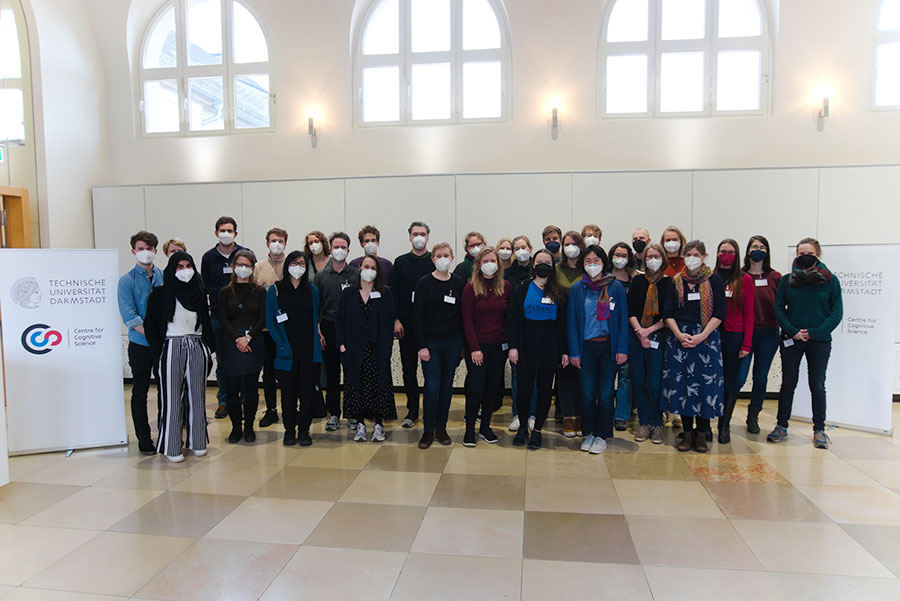
The Technical University of Darmstadt and its Center for Cognitive Science hosted the 2nd Doctoral Symposium on Cognitive Science, which focused on perspectives on learning and science communication. It took place from April 6 to 8, 2022. A total of 37 doctoral students from 14 different institutions in Germany and Austria participated in the symposium and presented research in the fields of cognitive neuroscience, artificial intelligence, and education.
Closing Remarks from the Organizers: We all thoroughly enjoyed the presentations and lively discussions during the symposium and would like to thank everyone for participating! We’d like to extend a special thank you to our keynote speakers on science communication, Jens Foell (NaWik) and Iris Proff (Science Media Center). We all gained many insights into this important topic and hope to incorporate some of their ideas into our own careers. If you are interested in organizing the 3rd GK Doctoral Symposium, please contact Prof. Barbara Kaup. We look forward to the next symposium!
Symposium at the University Tübingen 2020
23. and 24. Januar 2020
Organization: Francesca Capuano, Dania Humaidan and Gabriela Orellana Corrales.
On January 23 and 24, 2020, the first GK Doctoral Symposium on Cognitive Science took place at the University of Tübingen. The event was attended by 27 early-career researchers from 13 different institutions in Germany and Luxembourg, who presented their work on topics such as working memory, consciousness, embedded cognition, computer modeling, neuroscience, and artificial intelligence.
Despite the wide range of topics, the event was driven by a shared enthusiasm for advancing the scientific understanding of cognitive processes through the discussion of various approaches to this topic.